What I Wish Every Daughter Knew About Her Mother's Bathroom
I've walked into hundreds of homes over the course of my career as an occupational therapist and Certified Aging in Place Specialist.
I've sat at kitchen tables with worried adult children, I've held the hands of seniors who felt embarrassed by their own vulnerability, and I've stood in more bathrooms than I can count, assessing, recommending, and sometimes arriving just a little too late.
If you're reading this because you're concerned about your mother, I want you to know something first: the fact that you're thinking about this already puts you ahead of most families.
You're not overreacting. You're not being alarmist. You are paying attention, and that is an act of love.
The Bathroom Is the Most Dangerous Room in the House, and the Most Private
Here's what I know after more than two decades in this field: the bathroom is where falls happen. Not on the stairs. Not in the driveway. In the bathroom, where the floor is wet, the surfaces are hard, and your mother is alone.
The statistics are sobering, falls are the leading cause of injury-related death among older adults, but statistics aren't what keep me up at night. What I remember are the stories.
The woman who fell getting out of the tub on a Tuesday morning while her daughter was at work twenty minutes away. The man whose wife had no idea anything had happened for three hours.
I'm not telling you this to frighten you. I'm telling you because understanding the risk is what allows us to do something about it.
Your Mother Isn't Going to Bring This Up Herself
This is the part that surprises most families. You might assume that if there were a real problem, Mom would say something. She wouldn't.
Not because she's hiding things from you, but because the bathroom is deeply personal territory. Bathing, toileting, managing her own body, these are the last frontiers of independence for many older adults.
To acknowledge that the tub has become difficult, that she sometimes grabs the towel bar to steady herself, that she waits until she's absolutely sure she can make it, that feels, to her, like the beginning of the end.
So she stays quiet. And you don't ask, because you don't want to embarrass her. And in that silence, the risk grows.
What I've learned is that the conversation goes better when it comes from curiosity rather than alarm.
Not "Mom, I'm worried you're going to fall", but "Mom, I was reading about some of these new grab bars and honestly they look pretty sleek. Can I show you?" You're not taking something away. You're offering something.
Small Changes Make an Enormous Difference
One of the most reassuring things I can tell you is this: bathroom safety doesn't have to mean turning your mother's home into a clinical facility. The modifications that matter most are often simple, affordable, and surprisingly attractive.
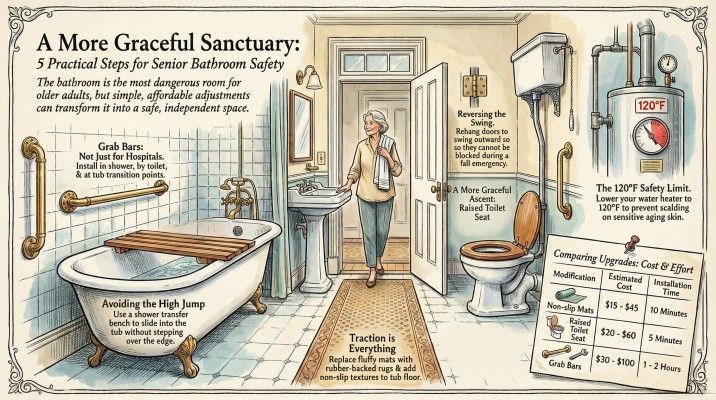
A well-placed grab bar by the toilet, installed properly into the wall studs, gives her something solid to push up from. A handheld showerhead means she can bathe seated if she needs to, without it feeling like a defeat.
A shower bench, a non-slip mat, adequate lighting, a raised toilet seat, none of these are dramatic interventions. They are quiet, practical acts of respect for a body that has worked hard for decades and simply needs a little more support now.
What I tell families is to think of these not as accommodations for decline, but as good design for real life. Plenty of people in their forties and fifties would benefit from a grab bar after surgery, or a handheld shower during an injury.
The difference is that for your mother, the need is ongoing, and the stakes of ignoring it are higher.
You Don't Have to Figure This Out Alone
A CAPS-certified professional can walk through your mother's home, and her bathroom specifically, and give you a clear picture of what's working, what's risky, and what can be done about it.
This isn't a sales pitch or a scare tactic. It's an assessment, grounded in clinical knowledge and a genuine understanding of how older adults move through their own spaces.
Often, families tell me afterward that they wish they'd done it sooner. Not because something had gone wrong, but because they finally had language for what they'd been quietly worrying about. The uncertainty lifts. There's a plan. That's worth something.
The Conversation Is an Act of Love
I want to leave you with this: bringing up bathroom safety with your mother is not about taking over or taking charge.
It's not about preparing for the worst. It's about saying, in the most practical terms possible, I want you to be here. I want you to be safe. I want you to stay in this home you love, for as long as you possibly can.
That's the whole point. That's always been the whole point.
And she may not say so, she may bristle a little, or change the subject, or tell you she's perfectly fine, but somewhere underneath all of that, she knows you're saying I love you.
And that lands, even when the grab bars don't go in right away.
If you'd like guidance on next steps, whether that's a home safety assessment, specific product recommendations, or simply knowing what questions to ask, check out the professionals on the Aging in Place Directory