What Does Retirement Even Look Like?
For older parents of adult children with disabilities, focus stays on caring for kids
Jeanne Piorkowski looks forward to having more time in retirement to navigate the dense bureaucracy of forms, benefits and programs she can already rattle off like an expert.
But she doesn’t expect to have much time to do new things, see new places or generally just relax.
Piorkowski, 64, of Newton, New Jersey, is among the hundreds of thousands of older Americans who have adult children with disabilities living with or dependent on them.
“Being retired would enable me to do more for Ray,” she says, referring to her 30-year-old son, who has Down syndrome. “But on the other hand, I don’t foresee being able to travel very much or doing the things that other retirees enjoy.”
More than 1.1 million adults receive Social Security benefits due to a childhood disability, and nearly 345,000 of them have parents receiving retirement benefits, according to Social Security Administration data.
There are probably far more families in this situation, as these numbers only include families receiving Social Security payments. And the challenges are becoming increasingly urgent as
more Americans reach retirement age and their children with disabilities live longer.

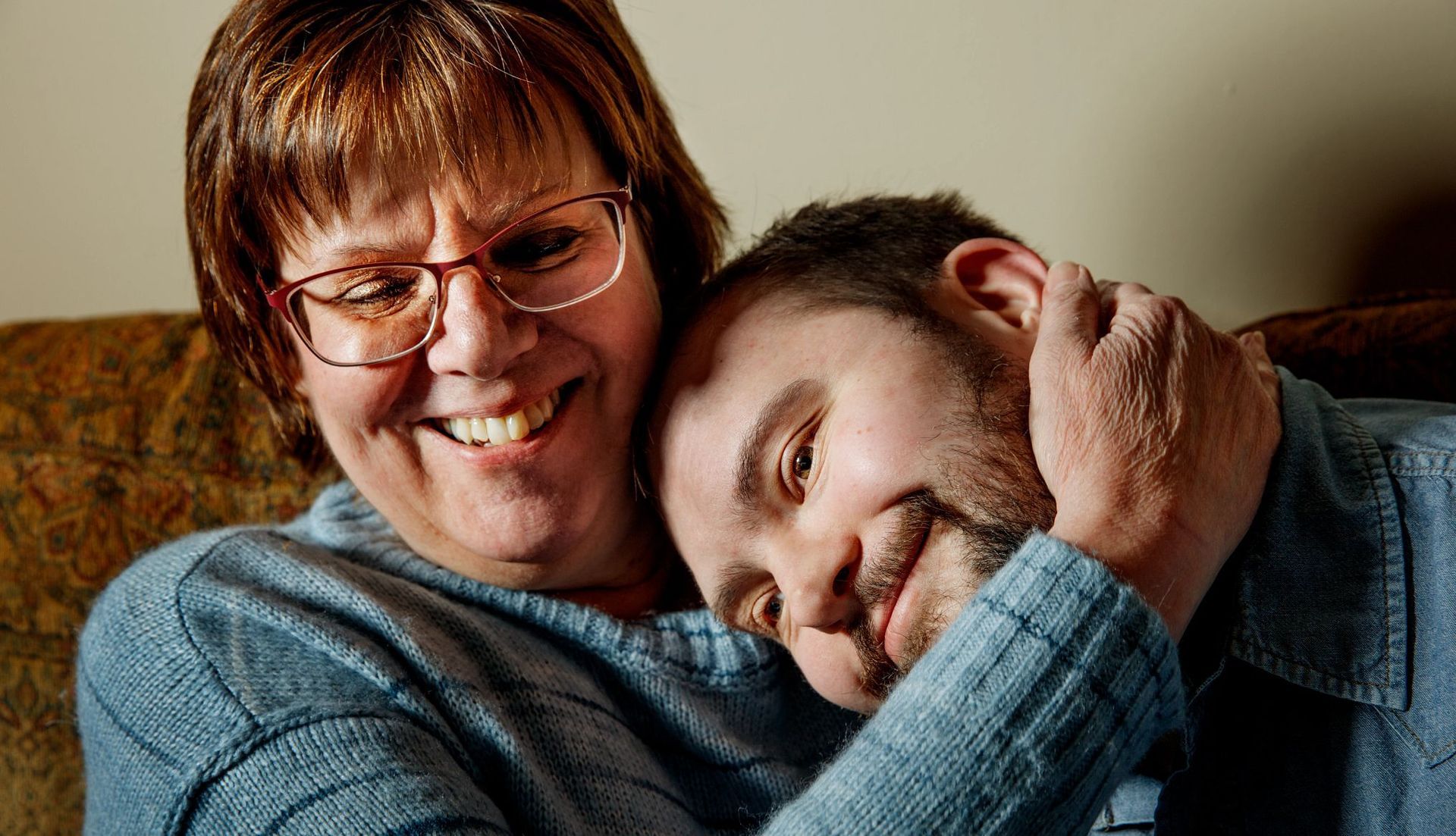
Ray gives his mom a hand making breakfast. Jeanne says they often prepare meals together.
PHOTOS BY ELINOR CARUCCI
“This is a really big issue and we’re right on the cusp of it becoming a much bigger problem,” says David Goldfarb, director of policy at The Arc, a national nonprofit that advocates for people with disabilities and their families and provides services through a network of state and local chapters.
“I would expect these issues to grow exponentially as the decade moves forward,” Goldfarb says. “Because society is getting older, we have more individuals that are going to need more supports and services.”
'Those families are really stretched thin'
The challenges begin well before retirement. Because of the time they must devote to caregiving, these parents often seek work that gives them flexibility to stay home with their children or to take them to activities or medical appointments, or they take part-time jobs without retirement plans. That can limit career prospects and economic horizons.
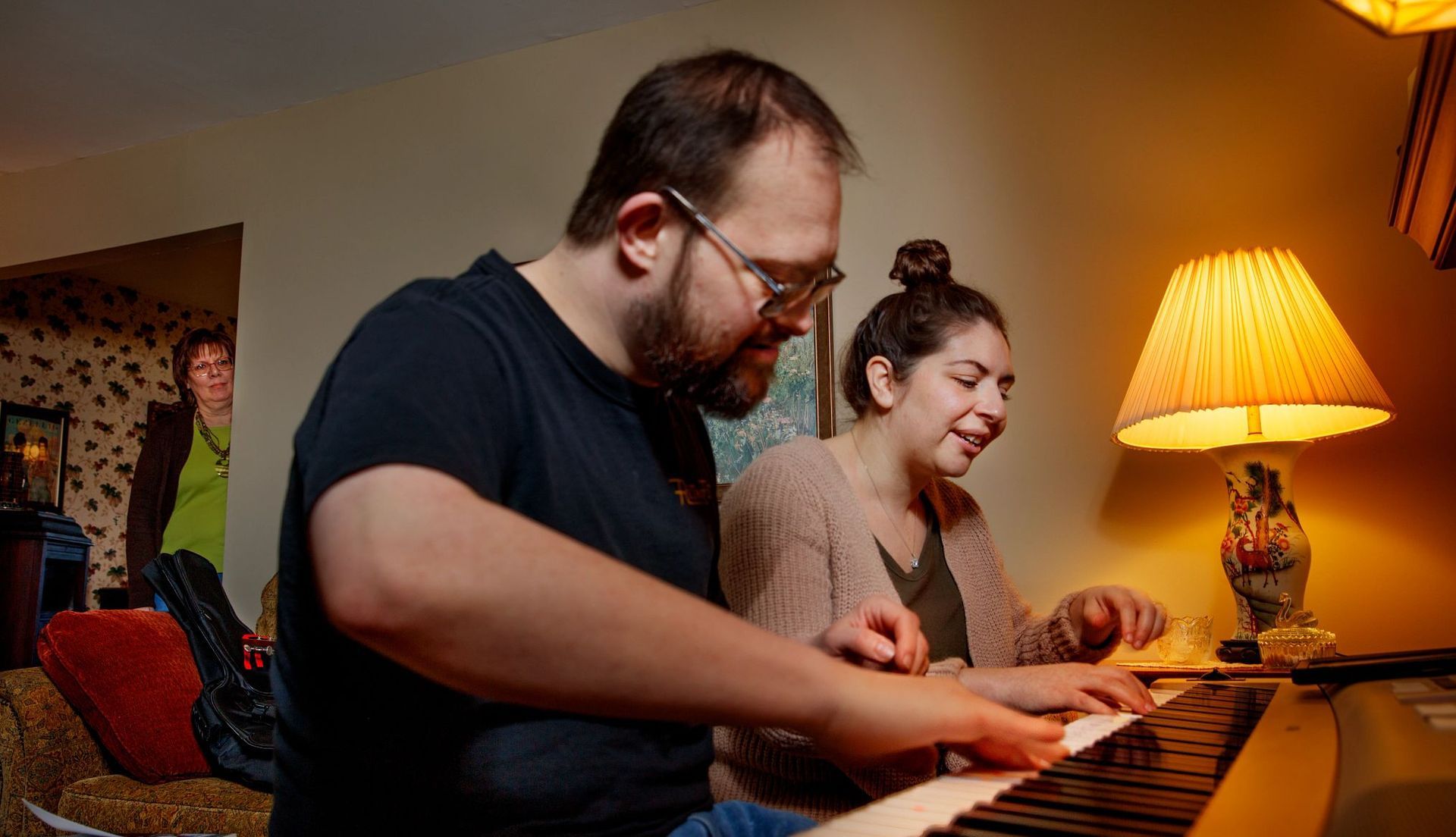
Ray gets a piano lesson from music therapist Julianna Altonjy as his mother, Jeanne, looks on.
Those with full-time jobs may forgo promotions that require moving to another state, since disability benefits differ from state to state and moving can mean starting the application process again from scratch, says Nancy Murray, former president of The Arc’s Pittsburgh-area chapter.
When Tamara Rampold and her husband retired, they and their youngest son, Shawen, who is 26 and has Down syndrome, moved from Illinois to Knoxville, Tennessee, to be closer to another of their three sons, who had just had a baby.
“We had barely gotten services in Illinois, then we had to start over in Tennessee,” says Rampold, 67. Her son’s state-provided Medicaid was interrupted for two months.
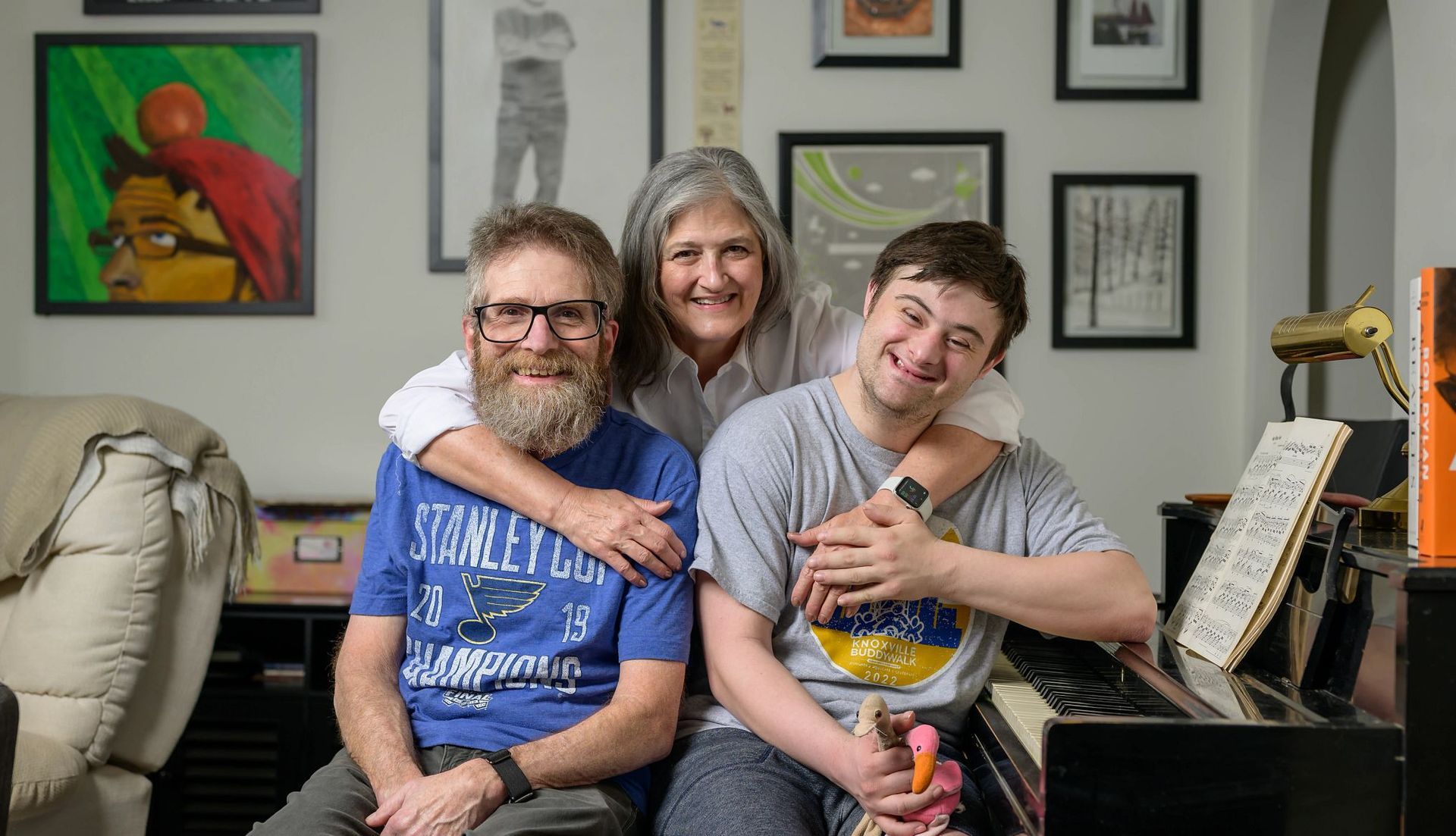
Tom and Tamara Rampold with their youngest son, Shawen, at their home in Knoxville, Tennessee, where they moved after the couple retired in 2022.
PHOTO BY WILLIAM DESHAZER
AARP research shows that caregiving disproportionately falls to women, and a February 2023 Urban Institute report prepared for the U.S. Department of Labor found that women earn $237,000 less, on average, over their working lives because of time they take off to raise children or provide care to parents or spouses. Mothers of children with disabilities often must step away from their careers for even longer, meaning they earn still less.
Because future payments from Social Security and workplace retirement accounts are tied to earnings, that lost income can “reverberate into retirement” and “jeopardize financial security in old age,” the Urban Institute study notes.
By retirement age, parents of children with disabilities have incomes nearly 25 percent lower than other parents and have saved less, according to a September 2023 report from the University of Wisconsin-Madison’s Center for Financial Responsibility on retirees with adult children with disabilities. Facing higher costs for things like medical care, home health aides and transportation, they’re likely to have trouble affording food, rent and utilities.
“They’re having to make all these trade-offs,” says Lisa Klein Vogel, a University of Wisconsin research scientist and a coauthor of the study. “Those families are really stretched thin.”
Health care costs can also cast a long financial shadow, says Staci Alexander, vice president for thought leadership at AARP and the parent of a 19-year-old daughter with autism and cerebral palsy.
“Many parents, even if their children are Medicaid-eligible and/or have private insurance, have been paying out of pocket for physical therapy, speech therapy and other services for years, due to provider shortages and the fact that many don’t accept any form of insurance,” she says. “This is money that could have gone towards retirement savings.”

Shawen dances to music in his living room. His parents had to reapply for Medicaid and other benefits after the family moved from Illinois to Tennessee.
Benefit rules and red tape
Benefits programs haven’t kept up — one limit on personal assets that affects how much federal assistance people with disabilities can receive hasn’t been updated in decades — and the process to qualify for them is a tangle of red tape. Minors with disabilities qualify for one kind of benefit, for instance, but in most cases, when they turn 18 they must qualify again for adult disability benefits.
“This paperwork is so daunting, and people are afraid of the penalties for getting it wrong,” Goldfarb says. “All of these benefits have different rules, and then you might need to appeal [after an initial rejection] to get these services. There is an enormous amount of complexity. It’s preventing people from getting benefits and getting the services they need.”
For example, Supplemental Security Income (SSI), a Social Security-administered program that provides monthly benefits for people with disabilities and limited financial resources, requires that individual recipients have no more than $2,000 in assets such as bank accounts, a cap that hasn’t been raised in 35 years and leaves little room for beneficiaries to save for emergencies or future needs.
“There hasn’t been a political will, I think, to increase benefit amounts, so they’ve just stayed low,” says Molly Costanza, coauthor of the University of Wisconsin study and a former research analyst at the Social Security Administration.
AARP has endorsed the SSI Savings Penalty Elimination Act, bipartisan legislation introduced in Congress in 2023 that would raise the individual income cap to $10,000 and index it to inflation.
There are tools parents can use to build greater financial security for children with disabilities without risking loss of benefits, Alexander notes. She cites Achieving Better Live Experience (ABLE) accounts, which allow people with disabilities to save up to $100,000 that is not counted against the SSI asset cap. The Arc chapters in many states operate pooled special needs trusts that similarly allow families to set aside money for future needs while protecting benefit eligibility.
But federal assistance is only part of the equation. There are nearly 700,000 people, including many with disabilities, on state waiting lists nationwide for services such as home health or adult day care and nonmedical transportation, according to the health policy research organization KFF (formerly the Kaiser Family Foundation). In some areas, particularly rural regions, such services aren’t available at all, the University of Wisconsin study says.
“There’s a huge lack of direct-support professionals, so even if they’re able to get off these wait-lists, there’s not enough individuals to provide the service, let alone the additional hours they might need,” Goldfarb says.
Handling such responsibilities becomes increasingly difficult for parents as they age, he adds. “They’re less able to handle certain tasks themselves — getting people out of bed or feeding them. They may not have the strength or the energy to do that.”

Shawen uses colored pens and notecards to keep track of different seasons of his favorite TV shows.
‘Retirement doesn’t mean the same thing’
Piorkowski hopes to retire at 67 from her paying job as an executive assistant at an insurance company. Until then, caring for Ray is like a second job, she says.
“I figure out his schedule, keep the budget, hire aides. If a person can’t make it or an activity is changed, it becomes a Rubik’s Cube. I’m trying to shift things around. It’s always shifting, always thinking.”
Now that she’s been doing it for so long, “it’s just life,” Piorkowski says. “I can imagine someone who doesn’t have the time and the resources could be missing out on a lot that their child is entitled to.”
Many parents of children with disabilities take a similar view. “I’m just kind of like, oh, OK, this is what we’re going to do,” says Rampold. “Millions of people have done this, so I can do it.”
That doesn’t make it any easier. “I don’t know how they get up in the morning and face another day,” Murray says of parents caring for adult children with disabilities.
Murray, who is 70 and newly retired, speaks from experience: As part of a host home program in Pittsburgh, she and her husband, Joe, took in three children with Down syndrome — one abandoned, one orphaned and one from an underdeveloped country. Now in their 50s, they ended up becoming family. (“They adopted us,” Joe quips.)
Friends of the couple “have moved south, they’ve moved to Florida, they play golf every day, they go out for dinner whenever they want,” Nancy says. “When you have an adult child with a disability, that’s just not your life.”
As they age, these parents often find themselves serving as dual caregivers. “It’s hard enough [caring for an adult child with a disability] when you have a spouse and a partner that are with you, but then all of a sudden your spouse or partner may die or become incapacitated themselves because of illness,” Nancy says. “Then you might have Mom who is now caring for the adult child with a disability and a husband with dementia.”
For these retirees, “the word ‘retirement’ doesn’t mean the same thing. You can’t just go to Mexico and chill out on the beach,” Vogel says. “What does retirement even look like when you’re giving up so much of your life?”
Many confront another responsibility: planning for what happens when they die. “If you were to ask any parent what their main concern is, probably most would tell you, ‘Who will take care of my child after I’m gone?’ ” says Piorkowski.
On that score, she is relatively lucky: Her other son, Calvin, is Ray’s coguardian.
“I’ve heard from some older parents the saying, ‘I pray to live one day longer,’ ” she says. “Meaning, we can’t bear to think of what will happen to our children without us. But nor do we want to live without them, because we love them so much.”
#homeaccessibility #homemodification #homehealthcare #aginginplace #aginggracefully #caregivers #disability #disabilityawareness #wheelchairuser #wheelchairaccessible #spinalcordinjury #physicallychallenged #safetyathome #elderlycare #graytsunami #healthylifestyle #accessiblematters #userfriendlyhome